
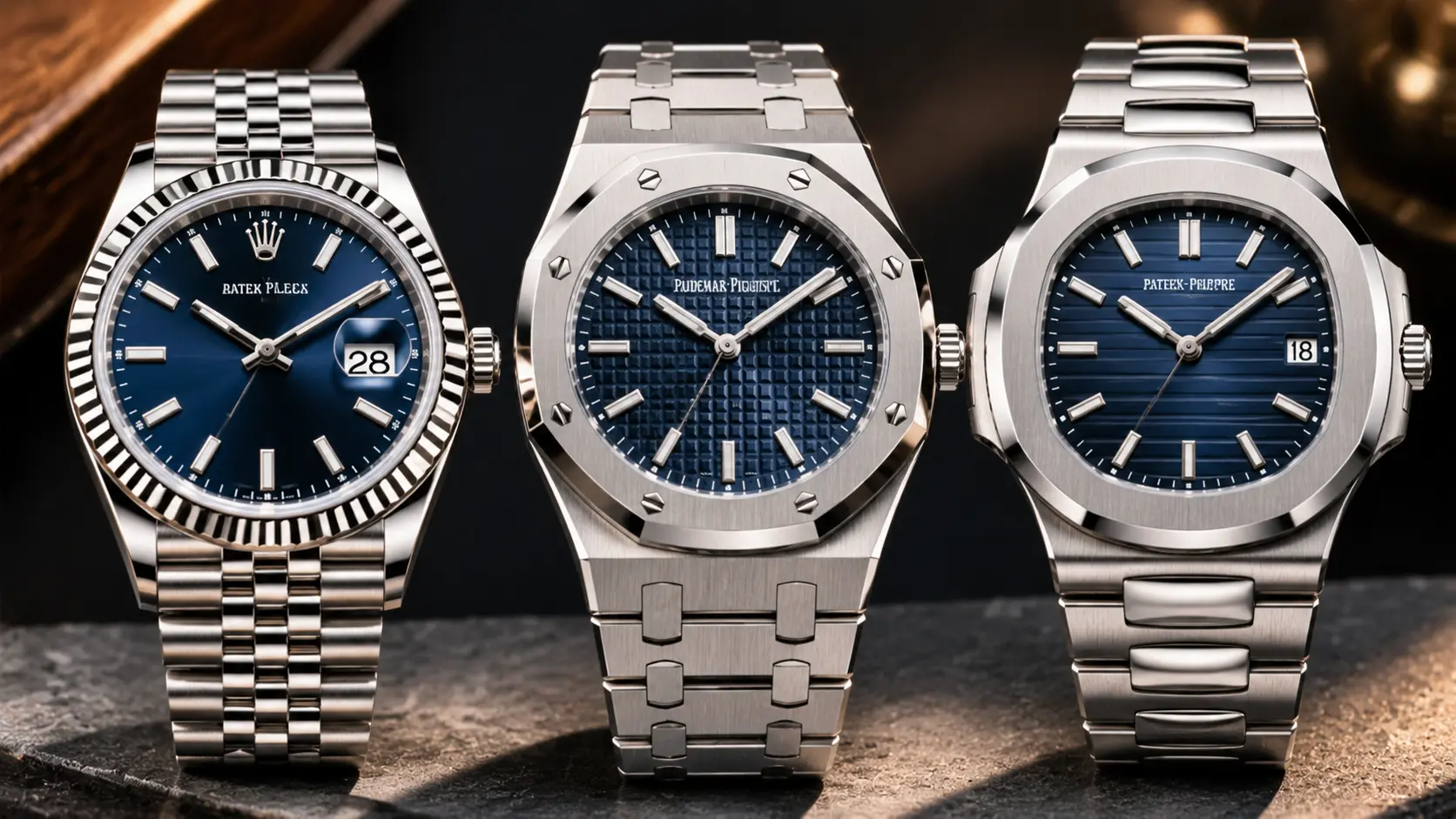
When exploring luxury watch designs, three names frequently stand out: Rolex, Audemars Piguet and Patek Philippe. Each has developed a distinctive identity through its case shapes, bracelets, dial designs and watchmaking traditions.
Rolex is widely recognised for its versatile Oyster-case watches, Audemars Piguet for the bold Royal Oak design, and Patek Philippe for elegant dress watches and sophisticated sports-watch styling.
For men in India exploring these iconic designs, the differences go beyond appearance. Case dimensions, bracelet construction, wrist comfort and finishing can all influence how a watch looks and feels.
This guide compares their design identities and explains what buyers should understand before choosing a particular style.
1. Rolex: Classic Design and Everyday Versatility
Founded in 1905, Rolex is one of the world’s most recognisable luxury watch manufacturers. Its design philosophy combines practical functionality with familiar, timeless styling.
Many Rolex models feature the Oyster case, developed as a water-resistant case design, along with carefully finished metal bracelets and balanced dial layouts.
Recognisable Rolex design features:
- Oyster-style case with a robust appearance.
- Oyster and Jubilee bracelet designs.
- Fluted or smooth bezel options on selected models.
- Luminous hands and hour markers on many models.
- Balanced dial layouts and practical date displays.
Some of its best-known collections include the Datejust, Submariner, Daytona and Oyster Perpetual.
The Datejust, introduced in 1945, became particularly recognisable for its date display. The Submariner, introduced in 1953, helped establish the modern luxury dive-watch design.
Case size and wrist fit
Datejust models are available in different sizes, including 36mm and 41mm. A 36mm model generally offers a more traditional, understated appearance, while a 41mm version creates a stronger wrist presence.
The bracelet design also affects comfort. An Oyster bracelet has a relatively conventional link structure, while the Jubilee offers a more intricate multi-link appearance.
Who may prefer this style?
Men who want a versatile watch design suitable for office wear, formal clothing and everyday occasions may appreciate Rolex’s classic styling.
2. Audemars Piguet: Bold and Architectural Sports-Watch Design
Founded in 1875, Audemars Piguet (AP) is particularly famous for its Royal Oak collection, introduced in 1972.
Designed by Gérald Genta, the original Royal Oak challenged traditional luxury-watch styling. Its stainless-steel construction, integrated bracelet and distinctive octagonal bezel created a new direction for luxury sports watches.
Recognisable Audemars Piguet design features:
- Octagonal bezel with eight visible screws.
- Integrated metal bracelet.
- Textured Tapisserie-style dial on many Royal Oak models.
- Alternating brushed and polished surfaces.
- Strong geometric case proportions.
The Royal Oak Offshore offers a larger and more muscular interpretation, while the standard Royal Oak collection includes different sizes, materials and complications.
Case size and wrist fit
The Royal Oak is available in different dimensions, including popular 37mm and 41mm versions, depending on the model.
One important detail is its integrated bracelet. Unlike a traditional bracelet attached between separate lugs, the first bracelet links extend directly from the case and can flare outward. This can make the watch appear wider than its case diameter suggests.
For someone with a smaller wrist, a 41mm integrated-bracelet watch may feel more substantial than a conventional 41mm round watch.
Who may prefer this style?
AP-inspired designs may appeal to men who like bold wristwear, geometric details and distinctive sports-watch aesthetics.
3. Patek Philippe: Understated Elegance and Fine Watchmaking
Founded in 1839, Patek Philippe is known for traditional Swiss watchmaking, refined finishing and complicated mechanical movements.
Its design identity ranges from understated dress watches to distinctive luxury sports watches.
Two important collections demonstrate this variety: the Calatrava and the Nautilus.
Recognisable Patek Philippe design features:
- Elegant case proportions and balanced dials.
- Carefully finished cases and bracelets.
- Traditional complications such as perpetual calendars and moon phases.
- Refined dress-watch styling.
- Distinctive integrated-bracelet sports-watch designs.
The Calatrava represents the brand’s classic round dress-watch identity. The Nautilus, introduced in 1976, is recognised for its porthole-inspired case shape, integrated bracelet and horizontally embossed dial on many models.
The Gérald Genta connection
An interesting detail in luxury-watch history is that Gérald Genta designed both the Audemars Piguet Royal Oak, introduced in 1972, and the Patek Philippe Nautilus, introduced in 1976.
This helps explain why the two collections share certain design characteristics, particularly their integrated bracelets and distinctive sports-watch case shapes. However, each has developed its own identity over time.
Case size and wrist fit
Calatrava models are available in different sizes, including examples around 39mm. The Nautilus also comes in several dimensions depending on the reference.
Like the Royal Oak, the Nautilus uses an integrated-bracelet design. Its overall wrist presence therefore depends on more than the diameter printed in the specifications.
Who may prefer this style?
Patek Philippe-inspired designs may suit men who appreciate refined proportions, elegant dials and traditional luxury-watch aesthetics.
Rolex vs Audemars Piguet vs Patek Philippe: Key Differences
Feature | Rolex | Audemars Piguet | Patek Philippe |
Design identity | Classic and versatile | Bold and architectural | Elegant and refined |
Famous collections | Datejust, Submariner | Royal Oak, Offshore | Nautilus, Calatrava |
Signature design | Oyster case | Octagonal bezel | Nautilus case |
Bracelet style | Oyster, Jubilee | Integrated bracelet | Integrated and traditional bracelets |
Overall appearance | Classic to sporty | Distinctive sports luxury | Classic to sophisticated sports |
Main appeal | Everyday versatility | Bold wrist presence | Traditional craftsmanship |
Understanding Their Watchmaking Approaches
Their differences are not limited to external design.
Rolex follows a highly integrated, industrial approach to luxury manufacturing, with an emphasis on precision, reliability, production consistency and quality control.
Audemars Piguet and Patek Philippe are especially associated with haute horlogerie—the higher end of traditional watchmaking, including elaborate complications, detailed movement finishing and specialised craftsmanship.
All three manufacturers produce technically sophisticated watches. However, their production philosophies, product ranges and areas of emphasis are different. It is more useful to compare individual movements and models than assume that every watch from one brand is automatically more technically advanced than another.
Which Design Suits Indian Men Best?
The right design depends on wrist size, clothing style and daily routine.
A few practical considerations are particularly relevant in India’s climate:
- Integrated bracelets: Royal Oak and Nautilus-style bracelets can feel substantial because of their construction. In hot and humid weather, a close-fitting metal bracelet may feel less comfortable if it is too tight.
- Polished surfaces: Highly polished steel and gold-coloured finishes can show fingerprints and visible scratches more easily than brushed surfaces.
- Wrist measurements: Measure your wrist and check case diameter, thickness and lug-to-lug dimensions. Bracelet shape can change how large a watch appears.
- Daily maintenance: Sweat and dust can collect around bracelet links, the case back and crown. Gentle cleaning with a suitable soft cloth helps maintain the exterior.
- Budget and authenticity: Genuine watches from these manufacturers occupy premium price segments, with prices varying considerably by collection, reference, material and availability. Verify authenticity and documentation through reliable sellers.
For buyers interested in these design styles, our website has separate collections featuring Rolex-inspired, Audemars Piguet-inspired and Patek Philippe-inspired designs:
- Explore Rolex-inspired designs
- Explore Audemars Piguet-inspired designs
- Explore Patek Philippe-inspired designs
Product transparency: These are commercial links to replica or inspired-design products listed on this website. They are not official manufacturer collections or genuine watches from Rolex, Audemars Piguet or Patek Philippe. Their movements, materials, construction and finishing may differ from the originals. Check individual product descriptions before purchasing.
Frequently Asked Questions
1. What is the main difference between Rolex, Audemars Piguet and Patek Philippe?
Rolex is recognised for versatile Oyster-case designs, Audemars Piguet for the bold Royal Oak sports-watch aesthetic, and Patek Philippe for refined dress watches and sophisticated sports-watch designs.
2. Did Gérald Genta design both the Royal Oak and Nautilus?
Yes. Gérald Genta designed the Audemars Piguet Royal Oak, introduced in 1972, and the Patek Philippe Nautilus, introduced in 1976.
3. Which is bigger: a 41mm Rolex Datejust or a 41mm Royal Oak?
Both have a nominal case diameter of 41mm, but they can wear differently. The Royal Oak’s integrated bracelet and case geometry can create a wider wrist presence than a traditional round watch.
4. Is the Patek Philippe Nautilus similar to the Audemars Piguet Royal Oak?
Both are influential luxury sports-watch designs associated with Gérald Genta. They share integrated-bracelet styling and distinctive case shapes, but their bezel designs, dial details and proportions are different.
5. What is the difference between a Rolex Oyster bracelet and an integrated bracelet?
An Oyster bracelet attaches to the case through conventional lugs. An integrated bracelet flows directly into the case design, creating a more continuous appearance, as seen on the Royal Oak and Nautilus.
6. Are replica watches the same as original Rolex, AP or Patek Philippe watches?
No. Replica or inspired-design watches are not genuine products from these manufacturers. Their materials, movements, craftsmanship, quality control and warranty can differ significantly.
Final Thoughts
Rolex, Audemars Piguet and Patek Philippe each represent a different direction in luxury-watch design.
Rolex offers recognisable versatility, Audemars Piguet stands out through bold architectural sports-watch styling, and Patek Philippe combines traditional elegance with sophisticated watchmaking.
When comparing these designs, look beyond the brand name. Consider the case dimensions, bracelet construction, finishing, movement and how the watch fits your wrist. These details will help you identify a design that complements your personal style.