
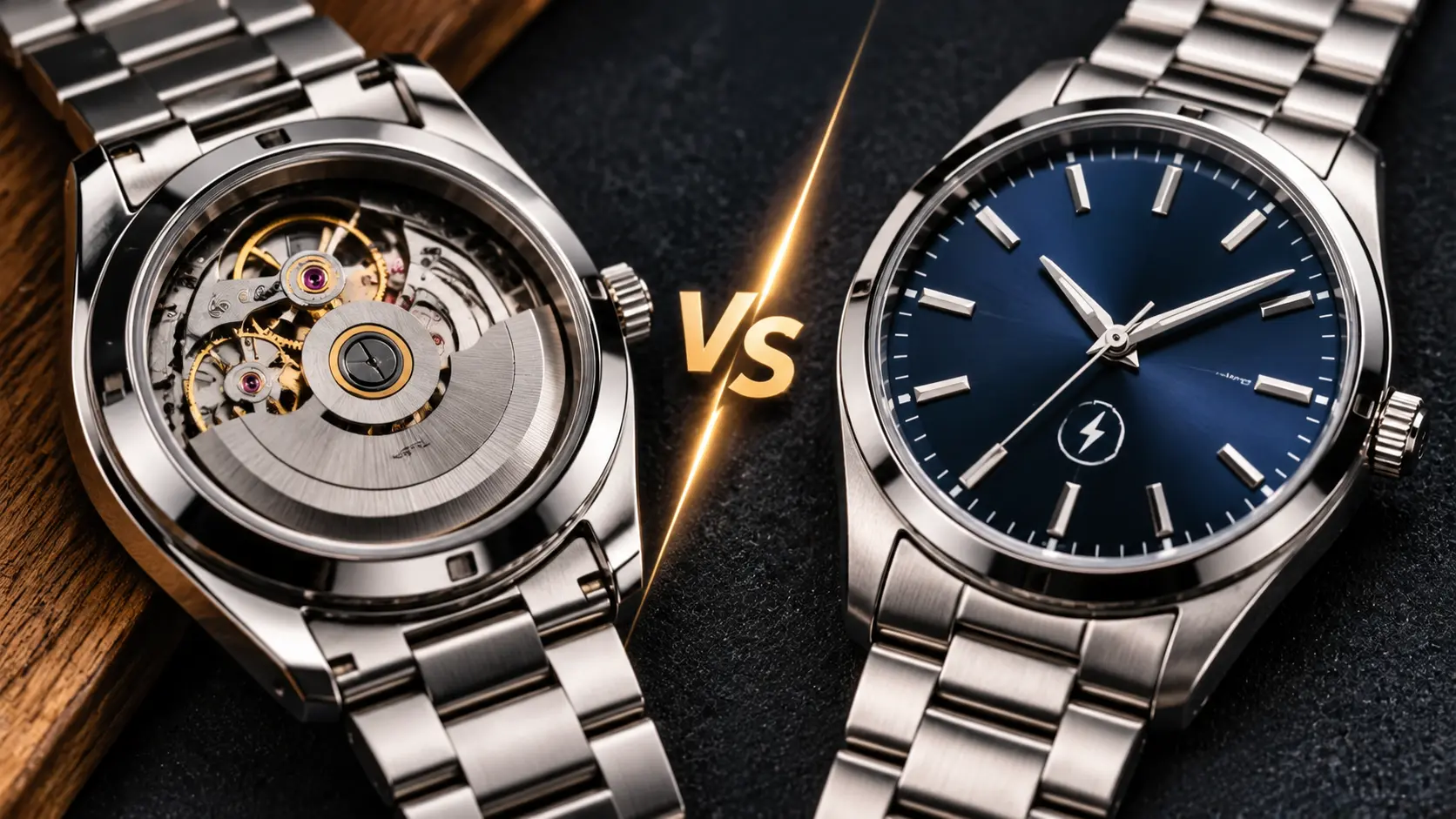
Choosing between an automatic and a quartz watch involves more than appearance. The movement inside affects accuracy, maintenance, durability and everyday convenience.
For men buying watches in India, understanding these differences can help avoid unnecessary maintenance costs and choose a watch that suits their lifestyle. In this guide, we compare automatic vs quartz watches, explain their advantages and disadvantages, and explore which movement makes more sense for everyday use.
What Is an Automatic Watch?
An automatic watch is a mechanical watch powered by a tightly wound spring called a mainspring. It does not need a conventional battery.
When you wear it, movement from your wrist rotates an internal weight called a rotor. The rotor winds the mainspring, which releases stored energy to operate the watch’s gears and hands. Many automatic watches also support manual winding through the crown.
Advantages of automatic watches
- No conventional battery: The movement uses mechanical energy.
- Traditional craftsmanship: Gears, springs and a rotor create an interesting mechanical mechanism.
- Long-term serviceability: A quality mechanical movement can be serviced and maintained for many years.
- Distinctive seconds hand: Most automatic watches have a visibly sweeping seconds hand.
Disadvantages of automatic watches
- Generally less accurate than quartz watches.
- Require periodic mechanical servicing.
- Can stop when left unworn until their power reserve runs out.
- May be affected by strong magnetic fields, shocks and temperature changes.
What Is a Quartz Watch?
A quartz watch uses an electrical power source, usually a battery, to operate. Electricity makes a tiny quartz crystal vibrate at a stable frequency. A typical quartz movement uses a frequency of 32,768 Hz, meaning the crystal vibrates 32,768 times per second.
An electronic circuit measures these vibrations and controls the movement. In a standard analogue quartz watch, a small motor moves the hands through gears.
Advantages of quartz watches
- High accuracy and dependable timekeeping.
- Usually lower maintenance requirements.
- Convenient for daily wear, travel and office use.
- Available across a wide range of prices.
- Generally simpler and less expensive to repair than many mechanical movements.
Disadvantages of quartz watches
- Conventional battery-powered models need battery replacement.
- Electronic components may require specialised replacement parts.
- Traditional quartz movements offer less mechanical complexity than automatic watches.
Automatic vs Quartz Watches: Key Differences
Feature | Automatic Watch | Quartz Watch |
Power source | Mainspring | Battery or electrical storage |
Accuracy | Usually measured daily | Usually measured monthly or annually |
Seconds hand | Usually sweeps in small steps | Usually ticks once per second |
Maintenance | Periodic mechanical servicing | Mainly battery and seal checks |
Power reserve | Often around 40–70 hours | Depends on battery or stored energy |
Case design | Often thicker and heavier | Often thinner and lighter |
Best for | Mechanical watch enthusiasts | Everyday convenience |
These are general comparisons. Specific movements can perform differently depending on their design and quality.
Accuracy: Which Watch Keeps Better Time?
Quartz watches are generally more accurate than standard automatic watches.
For example, some conventional quartz movements specify accuracy around ±15–20 seconds per month under stated conditions. By comparison, the Seiko NH35 automatic movement has a commonly published specification of approximately -20 to +40 seconds per day.
These figures are examples, not guarantees for every watch. Actual performance depends on the movement, adjustment, temperature and usage.
If you want accurate timekeeping with fewer adjustments, quartz is usually the better choice. If you appreciate mechanical engineering and traditional watchmaking, an automatic movement offers a different experience.
Sweeping vs Ticking: A Difference You Can See
One of the easiest ways to distinguish many automatic and quartz watches is by watching the seconds hand.
An ordinary quartz watch usually moves once per second, creating a noticeable ticking motion. An automatic watch typically moves in several smaller steps per second, making the seconds hand appear to sweep smoothly around the dial.
However, this is not a perfect identification test. Some quartz watches have high-frequency or sweeping seconds mechanisms, while automatic watches do not move in a completely continuous motion.
Other Watch Movements You Should Know
Not every watch fits neatly into the traditional automatic-versus-quartz comparison.
- Solar quartz: Technologies such as Citizen Eco-Drive and Casio Tough Solar convert light into electrical energy and store it in a rechargeable power cell. They reduce the need for regular conventional battery changes.
- Spring Drive: Developed by Seiko, this technology combines a mechanical mainspring with an electronic regulation system. It produces a distinctive smooth seconds-hand movement.
- Mecha-quartz: These chronograph movements combine quartz timekeeping with mechanical-style chronograph operation. They offer quartz convenience with a more traditional chronograph feel.
For Indian buyers who dislike frequent battery replacements but still want quartz convenience, solar watches are worth considering.
Watch Prices and Maintenance Costs in India
The purchase price and servicing cost depend on the brand, movement, materials and service provider.
Expense | Quartz Watch | Automatic Watch |
Typical entry-level price | Around ₹1,000–₹10,000 | Around ₹8,000–₹30,000 |
Routine maintenance | Battery replacement when required | Periodic mechanical servicing |
Indicative service cost | ₹300–₹800 for a basic battery change | ₹4,000–₹15,000+ for mechanical servicing |
Maintenance frequency | Battery life often around 2–3 years | Service interval depends on manufacturer and movement |
Important: These are broad indicative Indian market estimates, not official brand prices or fixed service intervals. Premium watches, water-resistance testing, replacement parts and authorised service centres can charge considerably more. Always request a quotation before approving repairs.
How Indian Conditions Affect Your Watch
India’s heat, monsoon humidity, sweat and dust make basic watch care important.
- Humidity and moisture: A damaged crown seal or worn gasket can allow moisture inside the case, potentially causing corrosion. Have water resistance checked periodically, especially before swimming.
- Sweat and dust: Sweat residue can collect around the case back, bracelet and crown. Clean the exterior gently with a soft cloth.
- Heat and sunlight: Avoid leaving a watch inside a hot parked vehicle or exposing it to extreme temperatures.
- Daily travel: Ordinary two-wheeler commuting does not automatically damage a mechanical watch. However, direct impacts, hard knocks and strong vibrations can affect delicate components. Shock protection varies by movement.
Neither movement type is automatically waterproof or shockproof. Always follow the manufacturer’s specifications.
Which Is Better for Daily Wear in India?
Choose a quartz watch if you want accurate timekeeping, convenience and lower routine maintenance. It is a practical choice for office use, travel and everyday wear.
Choose an automatic watch if you enjoy mechanical craftsmanship, prefer a traditional sweeping seconds hand and do not mind periodic servicing.
If you rotate between several watches, remember that an automatic model may stop when left unworn. A conventional quartz watch will generally continue running until its battery runs out.
Our recommendation: For convenience and accuracy, quartz is usually the sensible everyday choice. For mechanical appeal and traditional watchmaking, automatic is worth considering.
If you are interested in mechanical movements, read our guide to Swiss ETA watch movements to understand how these movements work.
Frequently Asked Questions
1. Is an automatic watch better than a quartz watch?
Neither is universally better. Automatic watches offer mechanical craftsmanship, while quartz watches generally provide better accuracy and easier maintenance.
2. Do automatic watches need a battery?
No. Traditional automatic watches use a mainspring wound by wrist movement or manual winding. They do not require a conventional battery.
3. How long does an automatic watch run without wearing it?
It depends on its power reserve. Many automatic watches offer approximately 40–70 hours, although some provide less or more.
4. Why does a quartz watch tick while an automatic watch sweeps?
A standard quartz movement usually moves its seconds hand once per second. An automatic movement typically moves the hand in several smaller steps each second, creating a sweeping appearance.
5. Are solar watches better than regular quartz watches?
Solar watches can be more convenient because they convert light into energy and store it in a rechargeable power cell. They still require proper care, and their rechargeable cells may eventually need replacement.
6. How often should an automatic watch be serviced?
There is no single interval for every movement. Follow the manufacturer’s service recommendations and seek inspection if the watch develops accuracy problems, moisture or unusual sounds.
7. How much does it cost to service a watch in India?
A basic quartz battery replacement may cost around ₹300–₹800, while mechanical servicing can start around ₹4,000 and exceed ₹15,000. Actual costs depend on the movement, parts and service provider.